Here’s the thing most travel blogs don’t quite spell out when they talk about Ang Thong. It isn’t an island destination in the way Samui or Phuket or Koh Tao are island destinations. Those places are somewhere you go, check into a hotel, rent a scooter, find a beach bar, and spend the week. Ang Thong is somewhere you visit, usually for about eight hours between ferry rides, then leave from and sleep somewhere else.
That single practical fact shapes everything about how a trip to Ang Thong actually works. Nobody lives there. There’s no guesthouse, no bar, no massage place on any of the 42 islands in the park, because park regulations don’t permit it. There’s one concession for basic overnight bungalows on Ko Wua Talap, run directly by the Department of National Parks, and that’s the entire accommodation inventory for the whole archipelago.
So when people ask how Ang Thong “differs from other Thai islands,” the honest answer is that it’s barely an island destination in the usual sense. It’s a protected national marine park that you access as a day-tripper from Samui or Koh Phangan, and the comparison to Koh Samui or Phi Phi mostly misses what’s actually going on structurally. This post is about what the experience is like in practice, how the comparison to the inhabited islands actually breaks down, and whether Ang Thong earns the detour from your Samui beach week.
What Ang Thong Actually Is
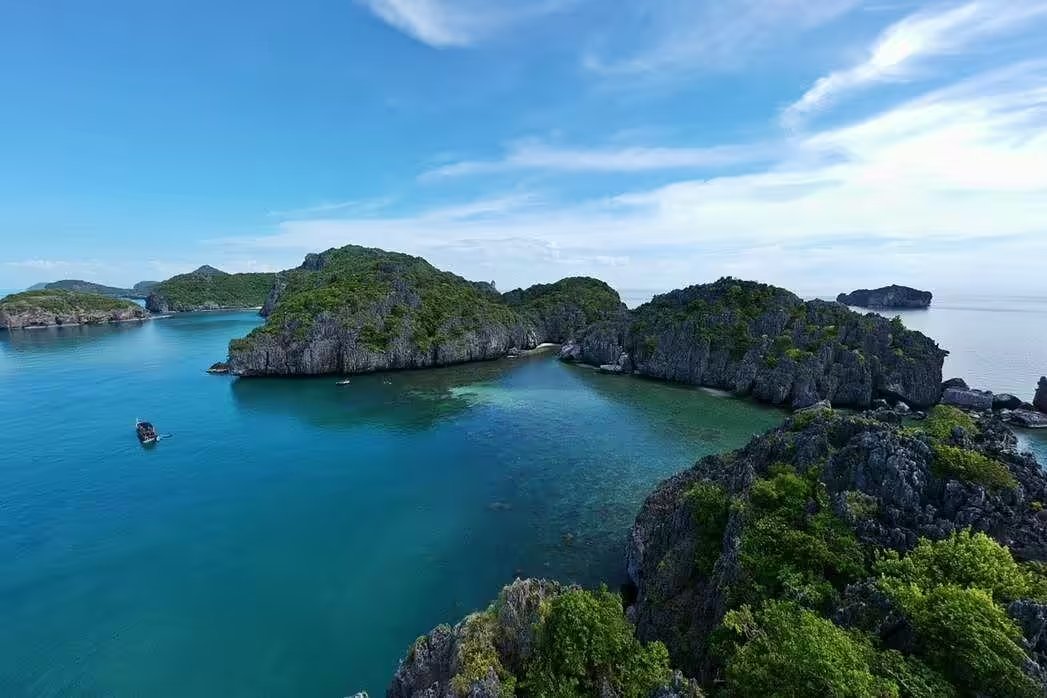
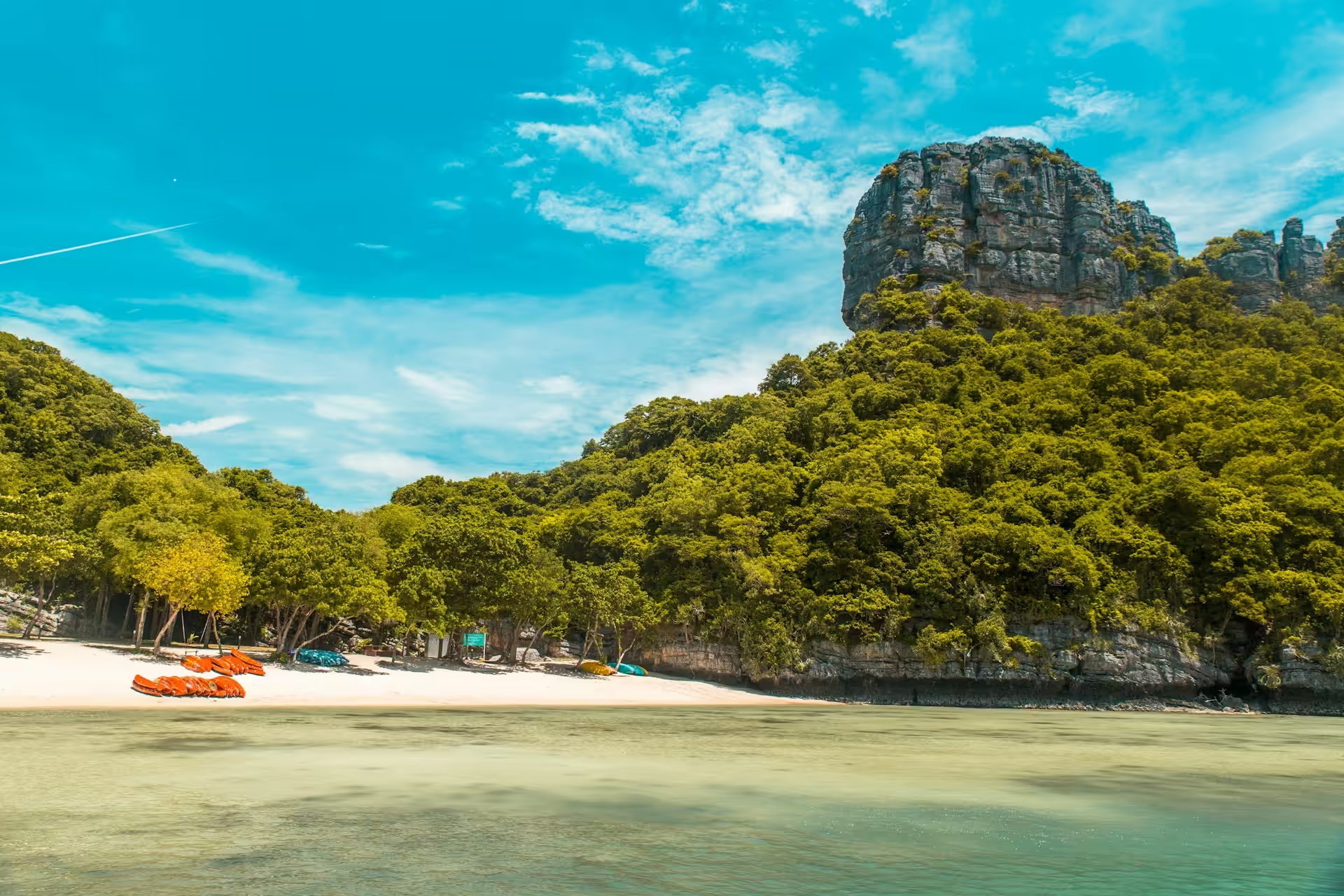
Ang Thong Marine Park was declared a protected area back in 1980 and sits about 30 kilometres west of Koh Samui. The park covers 42 islands of varying sizes, the largest being Ko Wua Talap and Ko Mae Ko, with most of the others uninhabited rocks rising dramatically out of the Gulf of Thailand. Limestone karst geology throughout, which is what gives you the classic Ang Thong photo: green-topped stone towers scattered across blue water, as if somebody designed a video game level and then handed it to nature.
There are no permanent residents. There’s no town. No shop, no restaurant outside the small canteen at the park headquarters on Ko Wua Talap, no ATM, no mobile signal across most of the archipelago, and no paved road anywhere. The only lights at night come from the DNP bungalow generators on Ko Wua Talap, which shut off around 10 p.m.
Getting there is itself part of the distinction. You go as a day-tour passenger on boats that leave from Nathon Pier on Samui or Thong Sala on Koh Phangan, typically around 8 in the morning. Transit is 1.5 to 2 hours each way on the standard slow boats, closer to an hour on the speedboats. The park charges 200 baht per foreign adult as a separate entry fee, which isn’t usually rolled into the tour ticket and is paid in cash when you land at the park. Most tours are back at their port of origin by mid-to-late afternoon.
So the basic structure of a day looks like this: wake up very early, take a boat for an hour or two, spend four or five hours on and around a few of the islands, take the same boat back, reach your hotel around 4pm thoroughly cooked by the sun. That’s the standard day. The alternative is booking one of the DNP bungalows on Ko Wua Talap and staying a night, which changes things significantly and I’ll come back to.
The Comparison to Samui, Phangan, Phi Phi, and Phuket
The other Thai islands people weigh Ang Thong against are inhabited places with real economies and real infrastructure, which makes them fundamentally different from Ang Thong in ways the usual “nature versus tourism” framing doesn’t really capture.
Koh Samui has around 65,000 permanent residents, an international airport, a ring road, major hospitals, international supermarkets, and accommodation running from basic guesthouses up to luxury hotels in the fifty-thousand-baht-a-night bracket. It’s a functioning town with a functioning economy that happens to also host a lot of tourists. Beaches range from nearly untouched on the north coast to fully developed party strips at Chaweng and Lamai. You could live on Samui for years without getting bored.
Koh Phangan, with around 13,000 residents, is the next step down in development. Still fully inhabited, still has full moon parties, yoga retreats, and plenty of accommodation across the price spectrum. Slightly scruffier than Samui overall, slightly more backpacker-oriented, plenty of long-stay expats making a version of life work on the island.
Koh Tao is smaller still at around 1,400 residents, and built almost entirely around the dive-training industry. Not as developed as Samui but still has restaurants, bars, dive shops, guesthouses, and an island economy that hums along year-round for the diving.
Phuket is at the other end of the spectrum from Ang Thong entirely. 400,000-plus residents, international airport, multi-lane highways, an actual city on the south coast, massive resort developments, Patong nightlife, everything you’d expect from a mid-sized Thai provincial centre plus a few hundred thousand tourists layered on top.
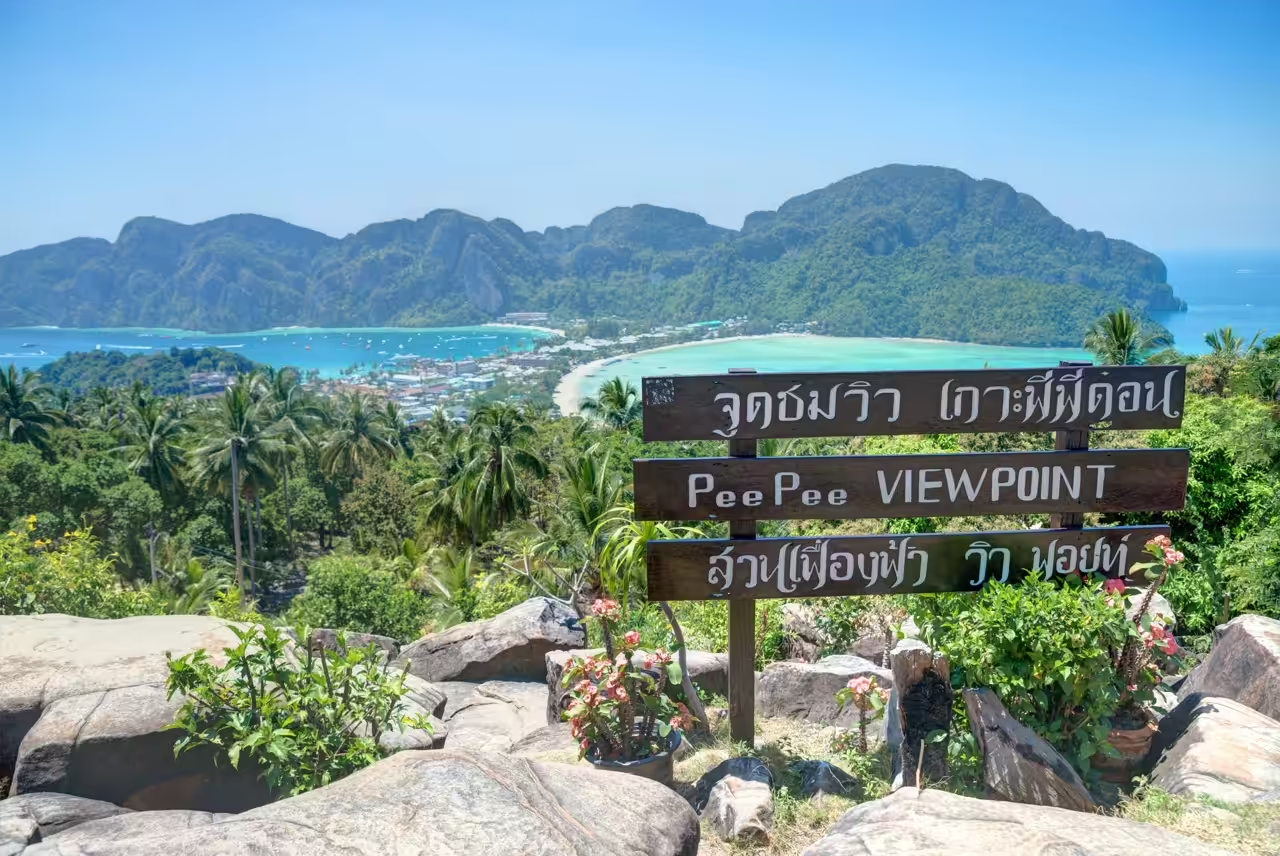
Phi Phi, closer to Ang Thong in scale (small islands, dramatic limestone scenery), is nonetheless inhabited enough to be its own tourist ecosystem. Tonsai Village packs restaurants, bars, dive shops, and accommodation onto a tiny footprint of flat land between the two bays, and the whole island runs at a frenetic pace during high season.
Ang Thong has none of this. The 42 islands have zero permanent residents, zero shops, zero restaurants off the small park canteen, zero nightlife. The “island experience” at Ang Thong is by definition a day-trip experience from somewhere else, not a “we spent a week on Ang Thong” experience, because the latter isn’t available. Which is the actual key difference, and the one most of the comparison articles fail to state clearly.
That doesn’t make it lesser, just different. It’s the difference between visiting a national park and visiting a town, and most Thai islands fall squarely into the town category while Ang Thong is about as close to pure national park as Thai tourism offers.
What the Experience Actually Feels Like
In practice, here’s what that structural difference translates to on the ground.
On Samui or Phi Phi, you’re a tourist in a place that exists partly for tourists. You have a hotel, you eat breakfast wherever looks decent, you figure out your day as you go, and you sleep somewhere comfortable at the end of it. The pace of the day is yours to set.
At Ang Thong the structure is different. You’re a visitor at a managed site, paced by the tour schedule and the park rules. You arrive with 40 to 100 other people depending on your boat type and the season. The itinerary is mostly fixed: viewpoint hike on Ko Wua Talap, Talay Nai hike on Ko Mae Ko, a couple of snorkel stops in between, picnic lunch provided by the operator, back on the boat when the captain says it’s time. The pace is set by the park and the captain, not by you.
This isn’t a criticism so much as the actual structure of how the park works. The “slower, less loud, more connected to the natural setting” framing you see in a lot of Ang Thong marketing is true in the abstract but needs a reality check. At 11 a.m. on any decent-weather day in season, the popular landing sites on Ko Wua Talap and Ko Mae Ko have tour boats anchored five or six deep, two hundred-plus tourists milling around the beaches, and queues on the viewpoint stairs. The “nature with room to breathe” moment happens either very early (if you’re on a tour that genuinely leaves Nathon at 8 a.m. rather than one that leaves at 9:15 pretending to be 8) or by paddling a kayak around the headland to somewhere the default itinerary doesn’t cover.
The genuinely different thing about Ang Thong, once you strip out the marketing, is that you’re in a landscape rather than a town. Even with 200 other people on the main beaches during the midday rush, you’re not surrounded by a built environment. The backdrop is still limestone and jungle. The water between the islands is clean because there’s no sewage infrastructure dumping into it. The views from the Ko Wua Talap headland are the same views that existed before any of us arrived here, minus the anchored tour boats.
That’s different from Samui or Phuket, where the landscape is mostly a backdrop to the tourism rather than the other way around. If that distinction matters to you, Ang Thong earns the day. If you don’t really care about the landscape-vs-built-environment difference, it’s a long day in a boat and possibly not the best use of your time on Samui.
The Overnight Option, and the February Question
The one way to actually extend the Ang Thong experience beyond a day trip is to book a bungalow at the DNP headquarters on Ko Wua Talap. These are basic (fan only, cold water, mosquito nets, fairly rustic) and bookable through the Department of National Parks website if you can manage a mostly-Thai booking interface, or through a handful of tour agents on Samui who handle the reservation on your behalf. Rates typically run 800-1,500 baht per night depending on the room type and how many people it sleeps.
The main advantage of staying a night is having access to the islands before and after the day-tour fleet arrives and leaves. At 7 a.m. on Ko Wua Talap you can have the main beach essentially to yourself. By 10 a.m. you’re watching fifteen tour boats anchor offshore and the beach fill up with people in bright orange life jackets. The contrast between those two pictures is striking, and really only possible if you sleep on the island.
It isn’t comfortable in a resort sense. The generator cuts off around 10 p.m. Dinner comes from the park canteen, which is functional but unexciting. Your phone won’t get signal on most of the island, which some people love and some find unsettling. But if what you want from Ang Thong is the quiet-morning experience the brochures promise, the overnight is how you actually access it.
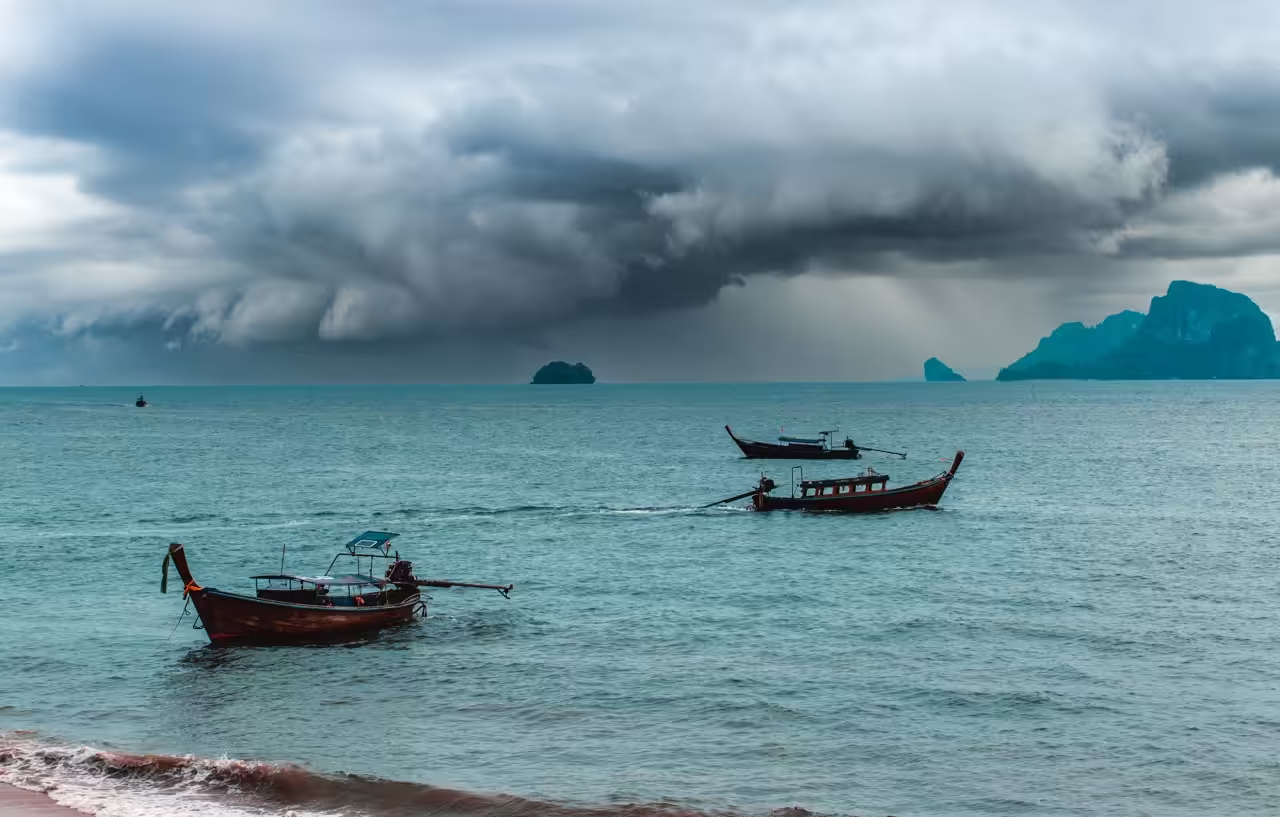
On the timing question, the original pitch of “February is perfect” needs qualification. Ang Thong sits on the Gulf side, which means its monsoon runs roughly November through January. The park has historically closed for several weeks during the heaviest part of that, typically reopening by mid-December or early January depending on conditions. By February the worst of the weather has passed, but the transition isn’t instant, and early February can still have rough-sea days that cancel tours. Late February through May is when the conditions are reliably good, with calm seas and the best underwater visibility of the year. That’s the real peak window, not February in isolation.
The brochures claiming “February is the perfect month” are half right. February is often fine, sometimes great, occasionally still blustery. Late February into May is when you can actually plan with confidence.
Who Should Actually Go
If you’re already based on Samui or Koh Phangan for a week and you want one day of dramatic limestone scenery and protected-water snorkelling, Ang Thong is worth the day. If the specific draw is kayaking, make sure the tour actually includes real kayaking rather than 30 minutes bobbing around the tour boat while the crew sets up lunch.
If you’re deciding between Ang Thong and spending that time on Koh Tao or at Phi Phi, that’s a different calculation. Koh Tao will give you better snorkelling in terms of marine life variety, and you can return to the sites over multiple days rather than ticking them off in one rushed day-trip. Phi Phi has more dramatic above-water scenery up close and more beach time if beach time is what you’re after. Ang Thong is a different product from either: a day in a landscape rather than time on a functioning island.
If the limestone-karst aesthetic is the main draw and you’re already nearby on Samui or Phangan, go. If you’re further afield and wondering whether to route through Samui specifically for Ang Thong, the answer is probably no. Phi Phi and the Krabi cliffs deliver similar karst scenery without the logistical friction of basing on one island and day-tripping to another.
If you’re putting together a Thailand trip and trying to weigh Ang Thong against the other islands, whether it earns a day, which specific tour actually delivers real exploration rather than the box-ticking speedboat loop, or how to fold it in alongside the rest of a Samui or Phangan stay, reach out about your travel to Ang Thong Marine Park and we’ll put something together that matches what you’re actually after rather than the default three-island circuit.
Ready to Explore Thailand’s Paradise Islands?
Join thousands of travelers who’ve seen Thailand’s best islands with our local guides. Contact us today to plan a personalized island adventure at a pace that actually suits you.